They aren't ready yet
Someone who hasn't moved in years won't easily book a session or turn up to a group. Many never make it to the first one.

For coaches and practitioners
One small move a day. One tap. Someone who notices.
Motion Over Mind helps people in midlife who've stopped moving start again, and keep going. The app carries the structure. You bring the attention, and you keep the relationship for when they're ready for more.
One move, one tap
The gap
The people who most need to move are the hardest to support initially. They don't need a programme yet. They just need a reason to put their shoes on tomorrow, and someone who notices when they do.
Someone who hasn't moved in years won't easily book a session or turn up to a group. Many never make it to the first one.
Between sessions nothing holds the habit in place. Often you only find out someone has stopped weeks after it happened.
A beginner needs a little support most days. Nobody can give that one to one, whether they charge by the session or hold a caseload.
Our pilot participants didn't describe choosing between us and a gym. They described gyms and classes as emotionally out of reach. Motion Over Mind is their on-ramp into fitness: it builds the habit first, so they arrive ready for what you offer next.
The method
The method comes from endurance sport, with the performance taken out. We lower the barrier to the doorway, not the effort.
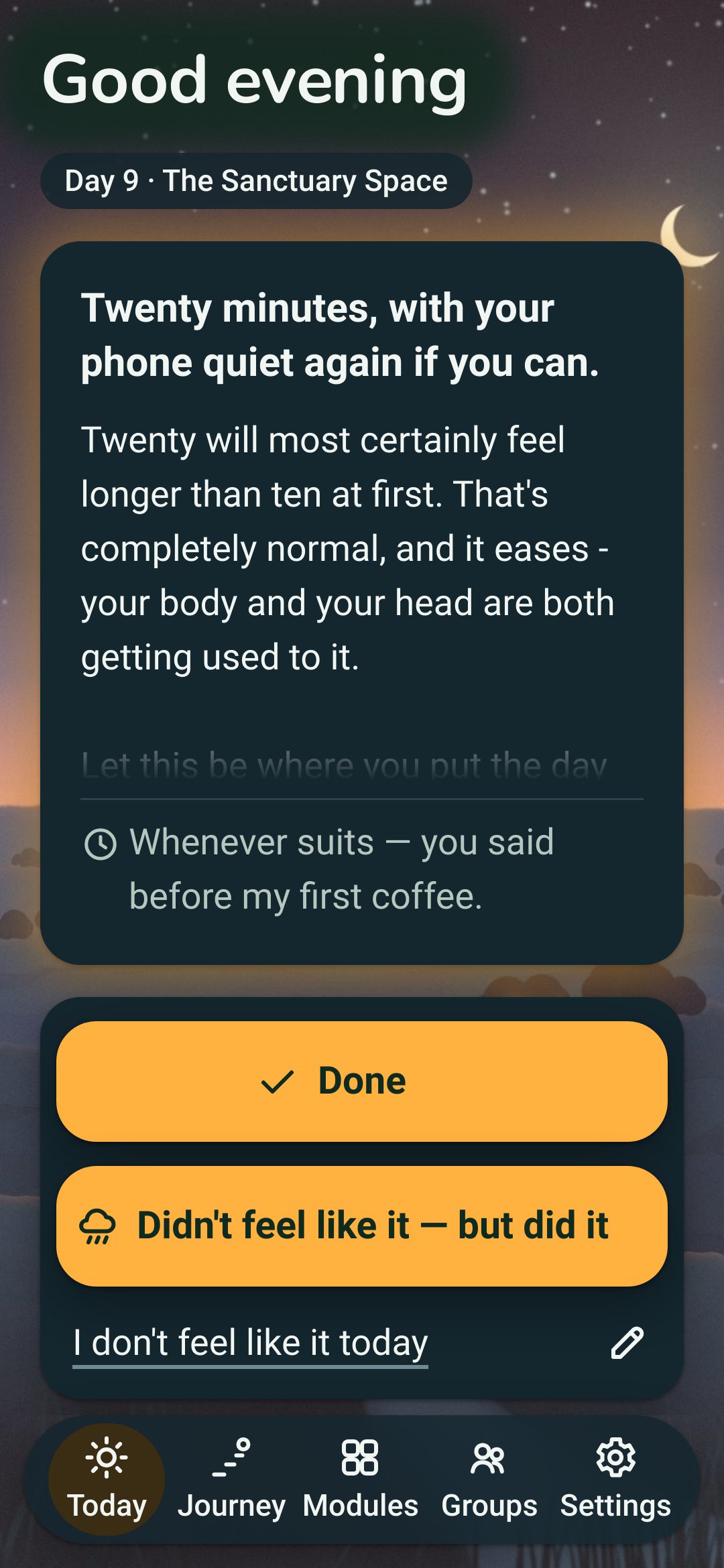
Ten minutes on day one. Shoes on, out the door, then decide. Gently increasing over time.
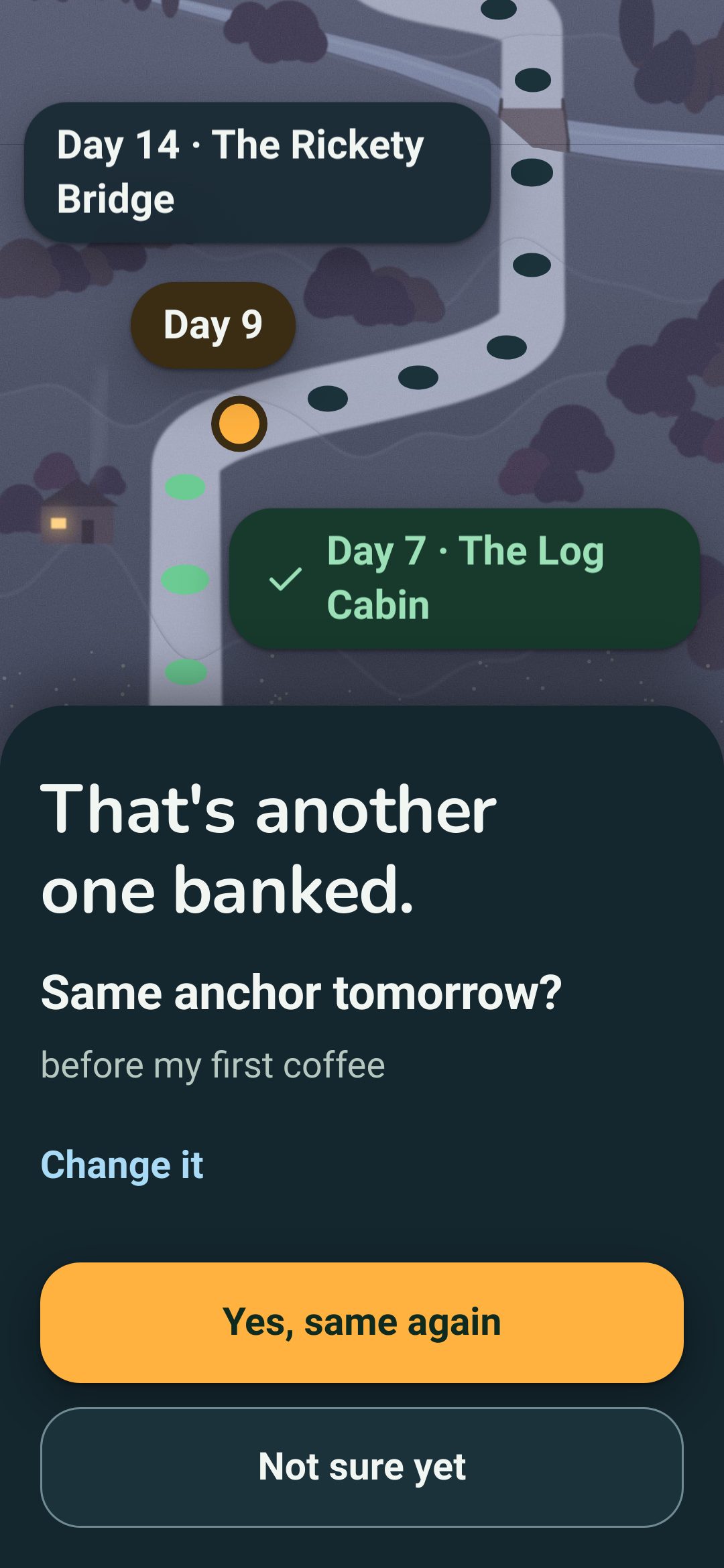
Movement hangs off a moment that already happens, like "before my first coffee". The app gives a gentle nudge to help.
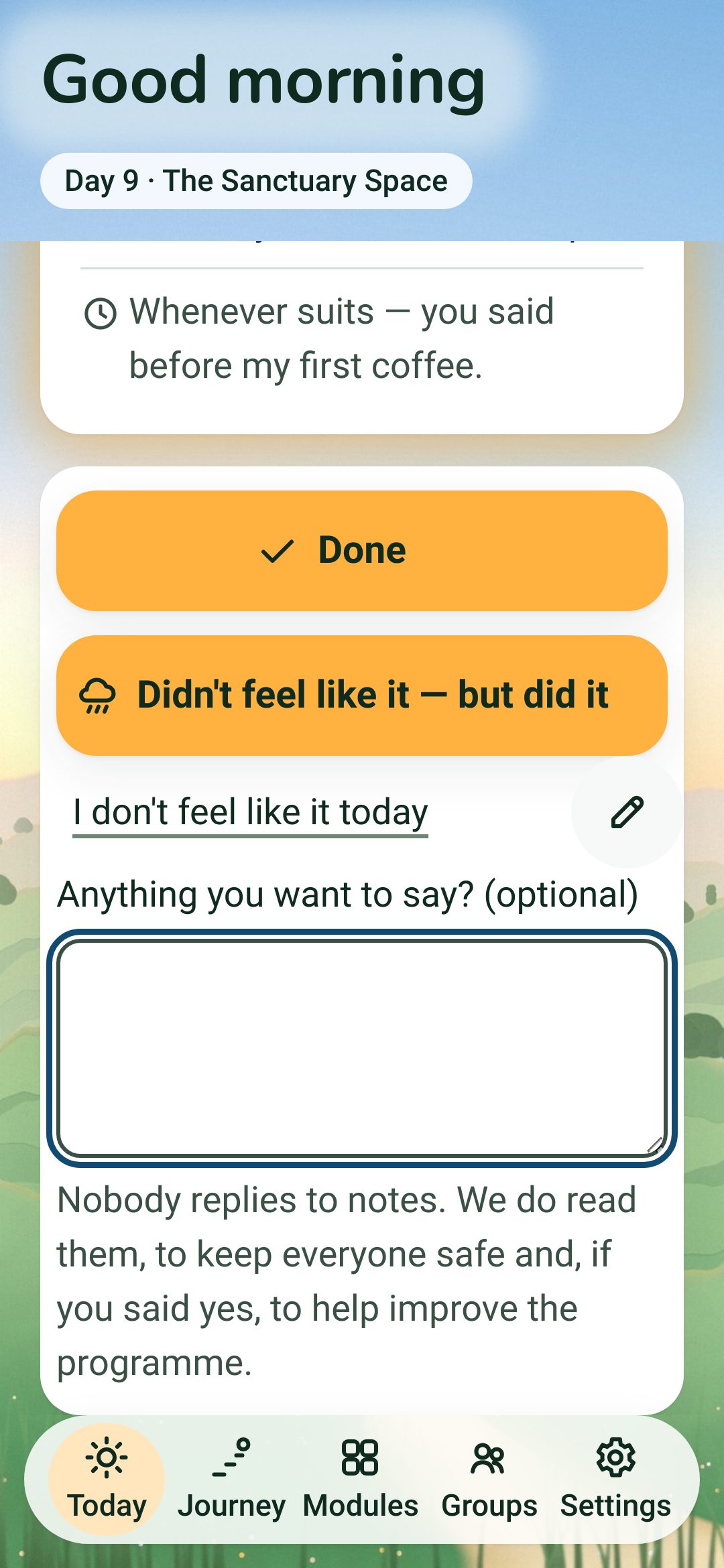
"Done", or "Didn't feel like it — but did it". Both move people on by exactly the same step. Only silence is a miss.
The habit comes first. Fitness follows as a by-product.
Every feature in the app passes one test
Could someone open the app and feel worse than before they opened it?
If the answer is yes, it doesn't ship, however well the feature might perform. It's about helping a client feel confident and happy, and building a stronger connection with fitness and wellbeing.
Here's the science
The method rests on two bodies of research: what a little movement does for body and mind, and how lasting habits form. Every finding links to its source, so you can check it or share it with your own clients.
"Those who are least active have the most to gain from increasing their physical activity."
1 in 10
If everyone managed half the recommended activity, 75 minutes of moderate movement a week, about 1 in 10 early deaths could be avoided. That is roughly 11 minutes a day.
Garcia et al., British Journal of Sports Medicine, 2023 · 196 studies, over 30 million people
7,000 steps
Compared with 2,000 steps a day, 7,000 was linked to a 47% lower risk of early death, 38% lower risk of dementia, 28% fewer falls and 25% less cardiovascular disease. Going from 2,000 to 4,000 already brought real gains.
Ding et al., The Lancet Public Health, 2025 · 57 studies
42 studies
Walking groups lowered blood pressure, resting heart rate, body fat and cholesterol, improved fitness and eased depression, with no notable side effects. Adherence averaged 75% where studies reported it.
Hanson and Jones, British Journal of Sports Medicine, 2015 · 1,843 people
Better sleep
Regular exercise brought moderate improvements in sleep quality, and small gains in how long and how well people slept.
Kredlow et al., Journal of Behavioral Medicine, 2015 · 66 studies
18% lower
Adults doing half the recommended activity had an 18% lower risk of depression than inactive adults. If everyone doing less than the guideline had reached it, around 1 in 9 cases of depression (11.5%) might have been prevented.
Pearce et al., JAMA Psychiatry, 2022 · 15 studies, 191,130 people
Walking works
Walking or jogging was among the most effective forms of exercise for depression, alongside yoga and strength work. Effects grew with intensity, so gentle movement is a starting point, not a ceiling.
Noetel et al., BMJ, 2024 · 218 trials, 14,170 people
12 weeks or less
Physical activity had medium effects on depression and anxiety, comparable to or slightly larger than talking therapy or medication. Programmes of 12 weeks or less showed the largest effects on depression.
Singh et al., British Journal of Sports Medicine, 2023 · 97 reviews, 1,039 trials, 128,119 people
One walk
After one bout of exercise, mood improved and anxiety and depressive symptoms eased, measured within half an hour afterwards.
Weinstein et al., Psychosomatic Medicine, 2024 · 103 studies, 4,671 people
Each row pairs a part of the method with the published research that backs it.
Every day starts with a small move, not a pep talk.
Behavioural activation, a talking therapy built on doing small, valued activities before mood improves, clearly beat control conditions for depression across 26 trials.
Ekers et al., PLoS ONE, 2014 · 1,524 people
Getting out on a day they didn't want to counts just as much as an easy day.
People consistently expect exercise to feel worse than it does, because they picture the hardest part, the start. Getting past the doorway is usually enough. Acceptance and commitment therapy, which teaches people to act on what matters to them even when their feelings say otherwise, outperformed comparison conditions across 39 trials.
Ruby et al., Health Psychology, 2011
A-Tjak et al., Psychotherapy and Psychosomatics, 2015 · 1,821 people
Every hard day done is proof they can do it again.
Having done it before was the strongest source of people's confidence to be active. In a lab study, regular exercisers' mood held up better under stress than non-exercisers'. That link is modest, and the study can't show cause.
Egele et al., Health Psychology and Behavioral Medicine, 2025 · 335 adults
Childs and de Wit, Frontiers in Physiology, 2014 · 111 adults
Ten minutes on day one, and "too easy" is the point.
The UK's physical activity guidelines say "Any activity is better than none". They add that people who do the least now have the most to gain from doing a little more.
UK Chief Medical Officers' Physical Activity Guidelines, 2019
An anchor moment, and their own "if that happens, I'll…" plans.
Plans in the form "if this happens, I'll do that" had a medium-to-large effect on reaching goals across 94 tests. In studies of physical activity specifically, the benefit lasted: it was still there at follow-up.
Gollwitzer and Sheeran, Advances in Experimental Social Psychology, 2006
Bélanger-Gravel et al., Health Psychology Review, 2013 · 26 studies
No resets. The day moves on only when they check in.
Missing a single day did not materially affect how automatic a new daily habit became. Habits took a median of 66 days to form, but anything from 18 to 254. A 2024 review found 59 to 66 days typical and 4 to 335 for individuals, with self-chosen habits forming more strongly. That's why the journey carries on past week 8, through further modules.
Lally et al., European Journal of Social Psychology, 2010 · 96 people
Singh et al., Healthcare, 2024 · 20 studies, 2,601 people
Nothing to break, so nothing to lose. We see a missed day as a pause between two successes.
Showing people a broken streak reduced how much they kept going, more so when they blamed themselves for the break.
Silverman and Barasch, Journal of Consumer Research, 2023 · seven studies
A hard day done counts the same as a good one.
More self-compassionate people looked after their health more, in every one of 15 samples. Part of the reason: being kinder to yourself lifts your mood, and a better mood makes looking after yourself easier.
Sirois et al., Health Psychology, 2015 · 3,252 people
Check-ins they record, and a coach who reads them.
Monitoring progress helped people reach their goals, more so when it was recorded or reported to someone else. In digital mental health programmes, guidance from people who aren't clinicians, such as peers and lay supporters, added a small but real benefit over going it alone, and matched guidance from clinicians.
Harkin et al., Psychological Bulletin, 2016 · 138 studies, 19,951 people
Leung et al., Journal of Medical Internet Research, 2022 · 13 trials, 3,227 people
What your clients see
It's built from the phone's own conventions, so anyone who uses a smartphone will find its features familiar. Large text, big buttons, and scenes that follow the time of day. We've made it simple by design and kept the complexity out of sight.
Swipe to see six screens.
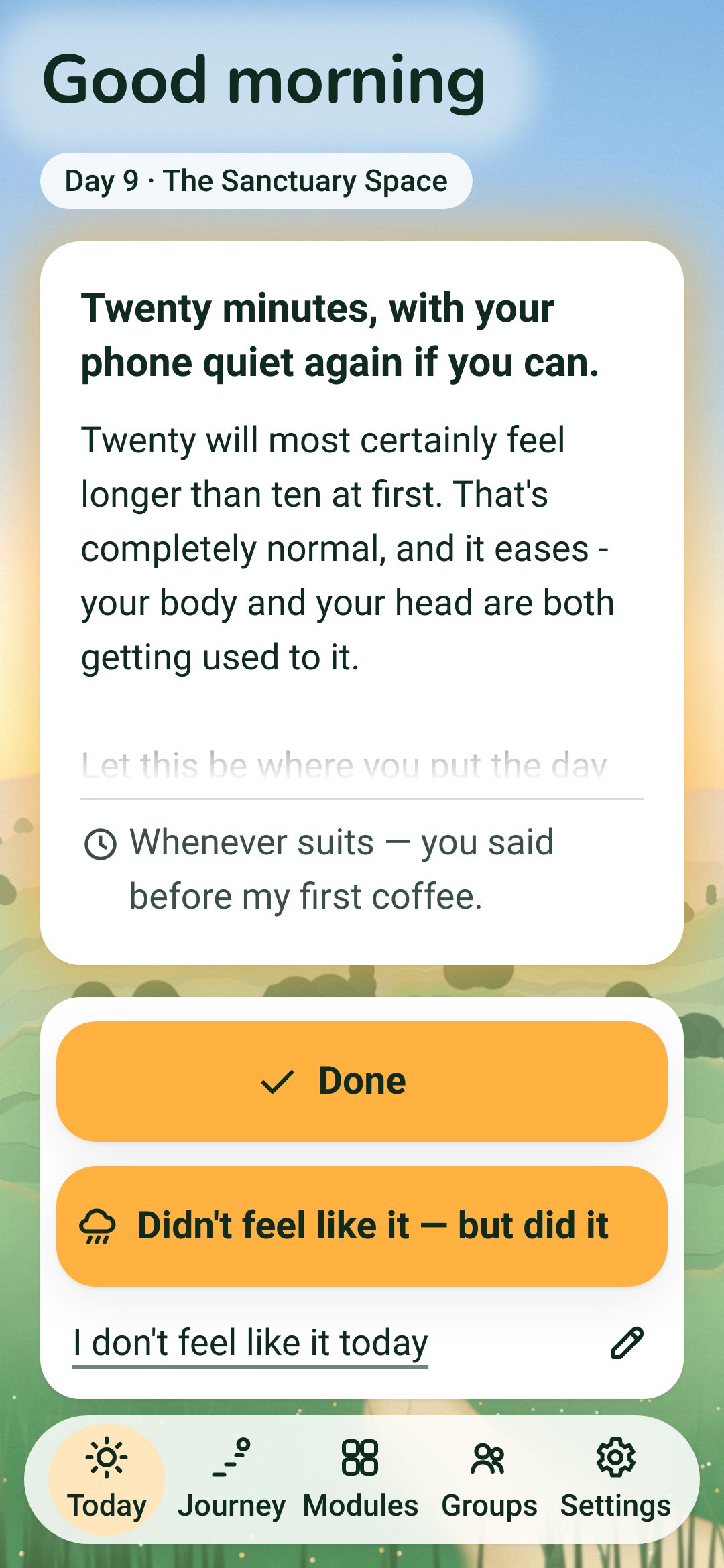
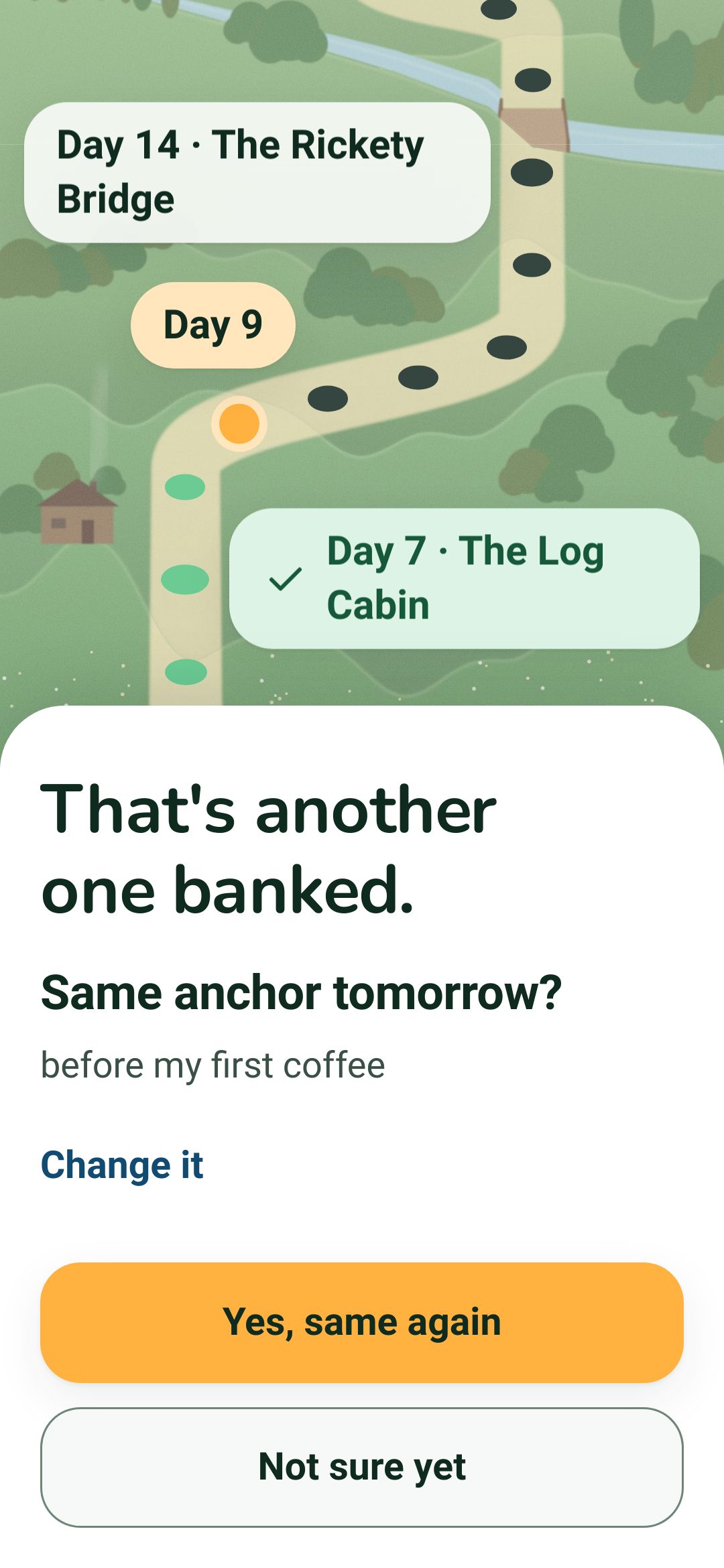
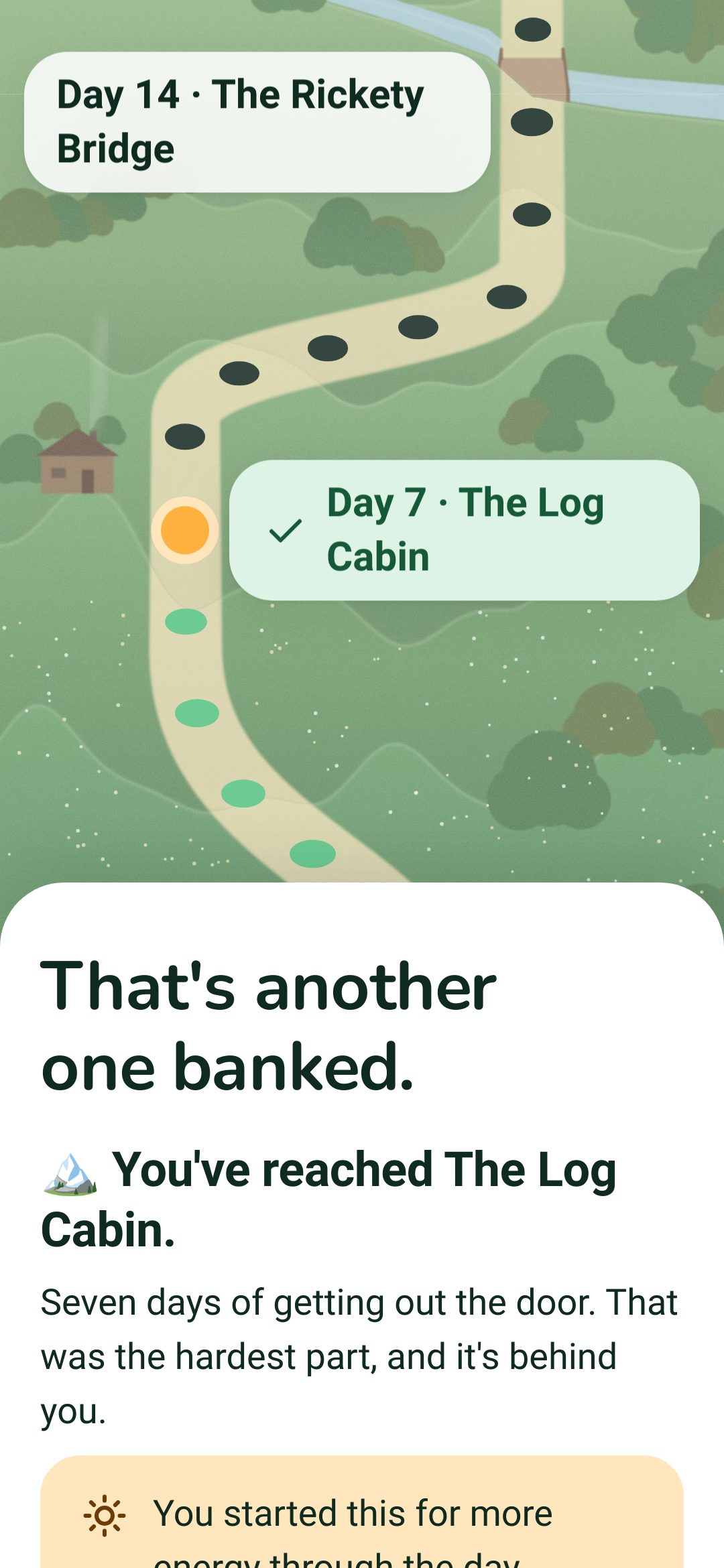
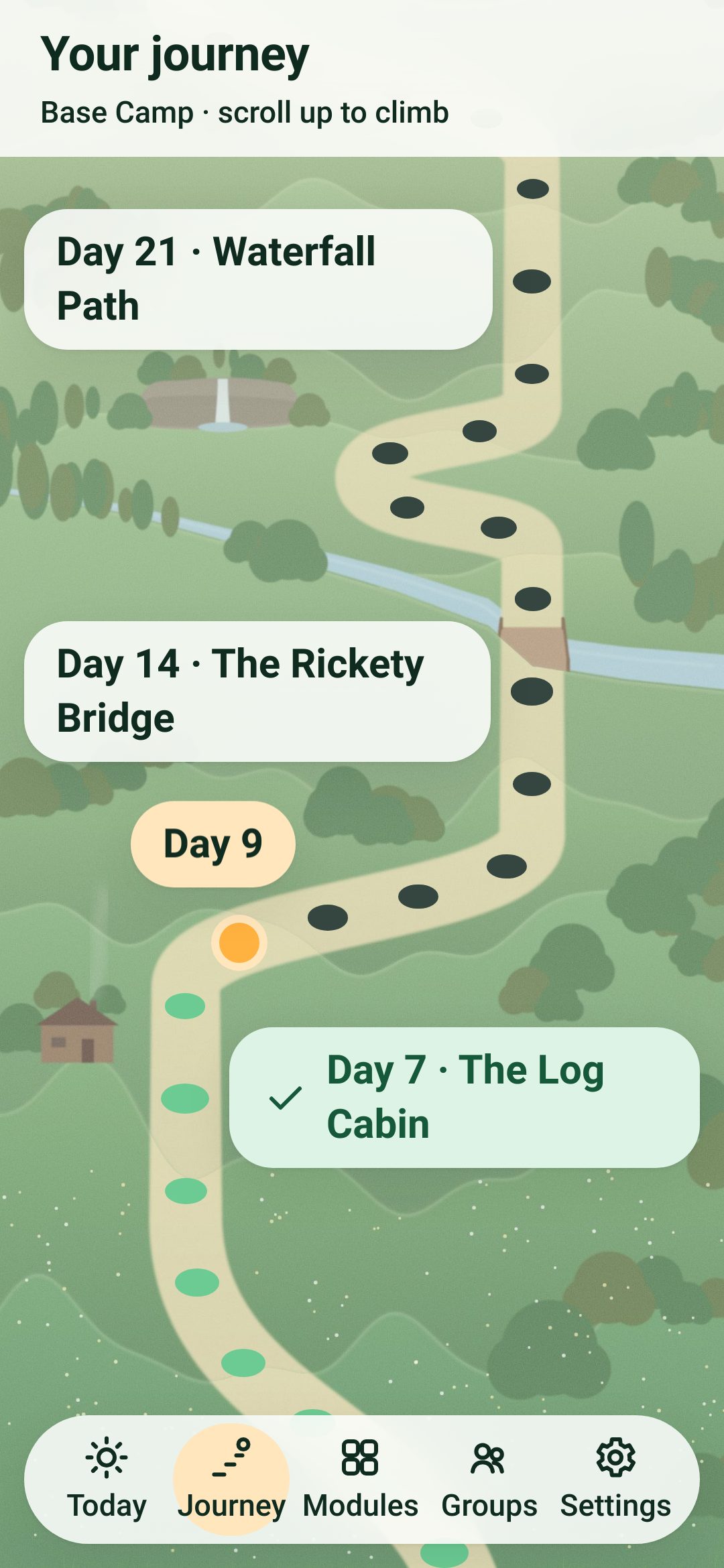
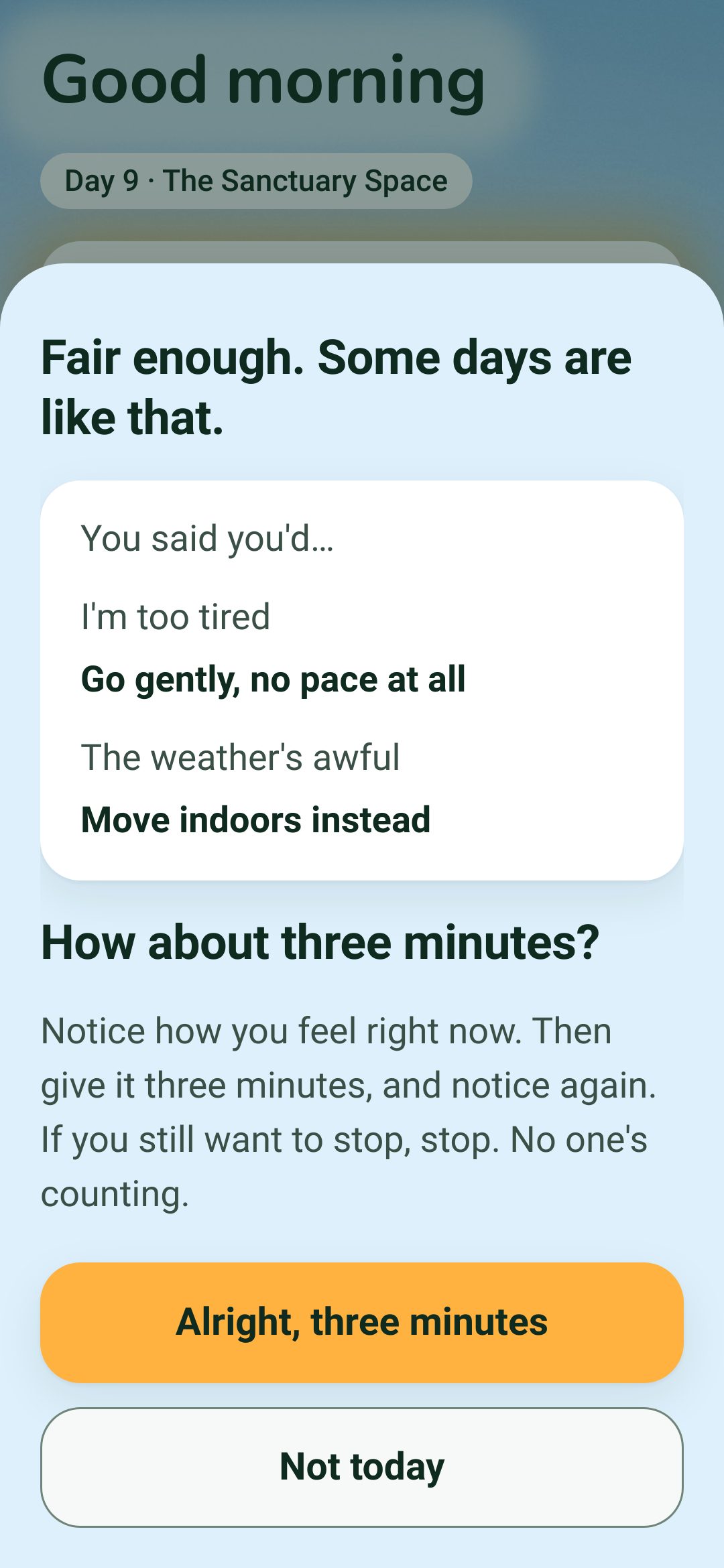
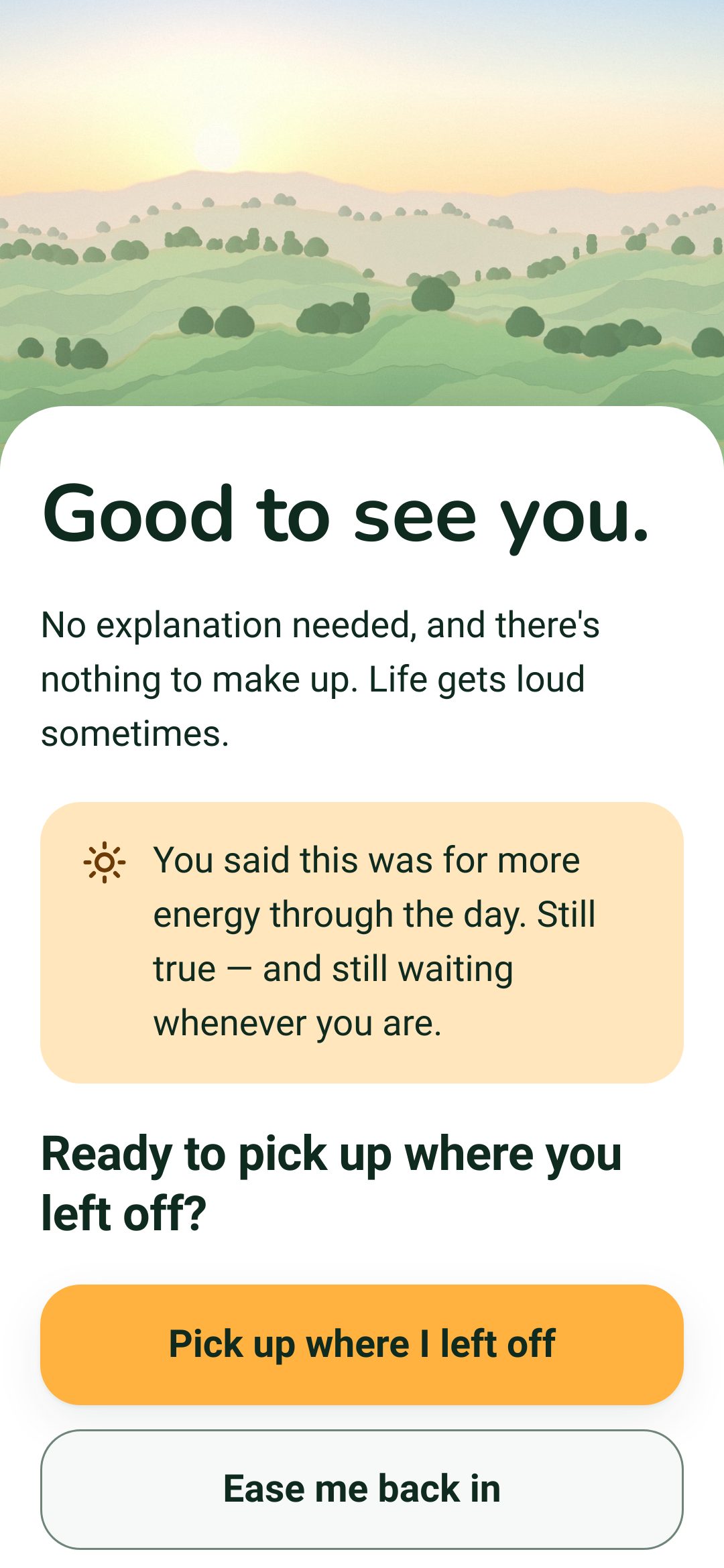
Screens from the app in testing, October 2026. Some words may change before launch.
What you see
Your coach view is simple and read-only. It doesn't ping you for every check-in. You look at set times, late morning and evening suits most coaches, and reply in your own words.
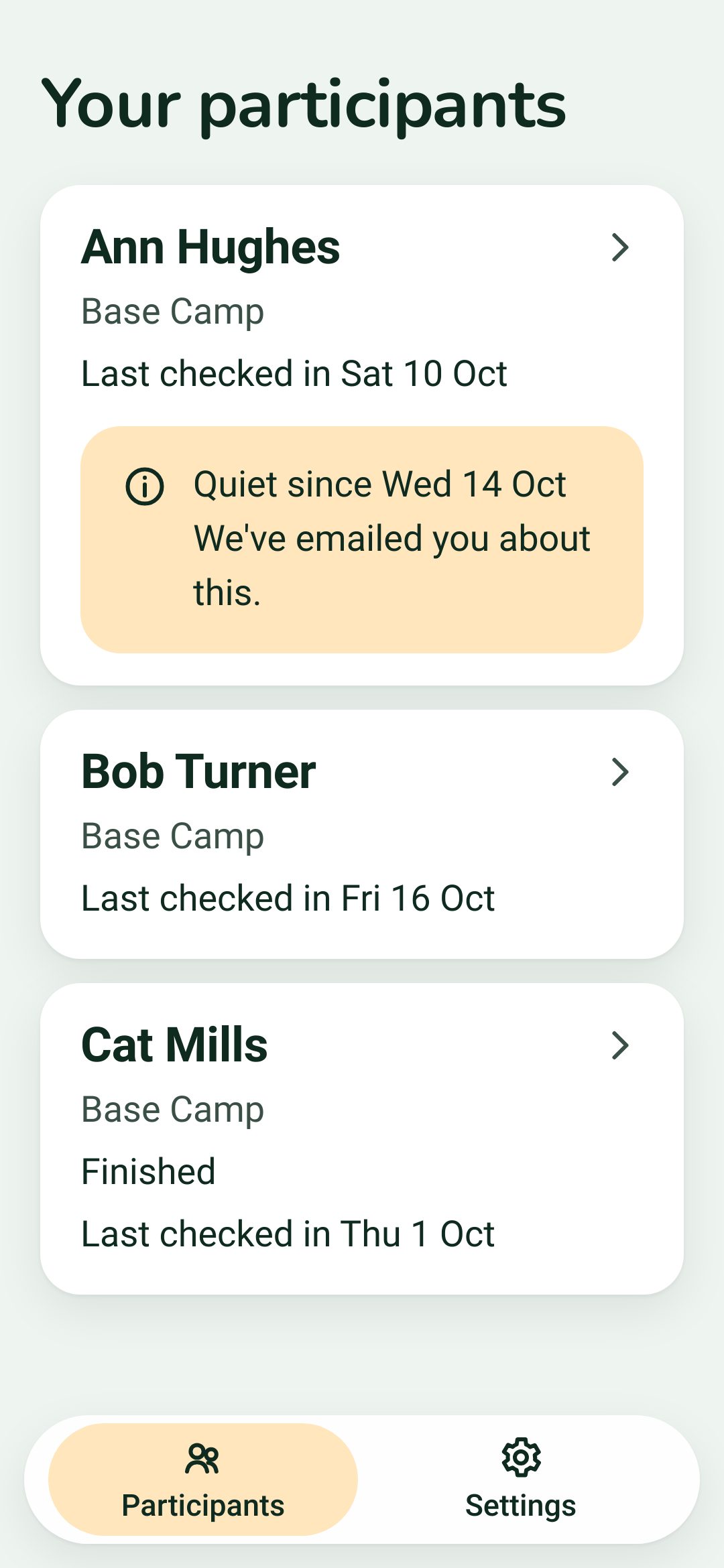
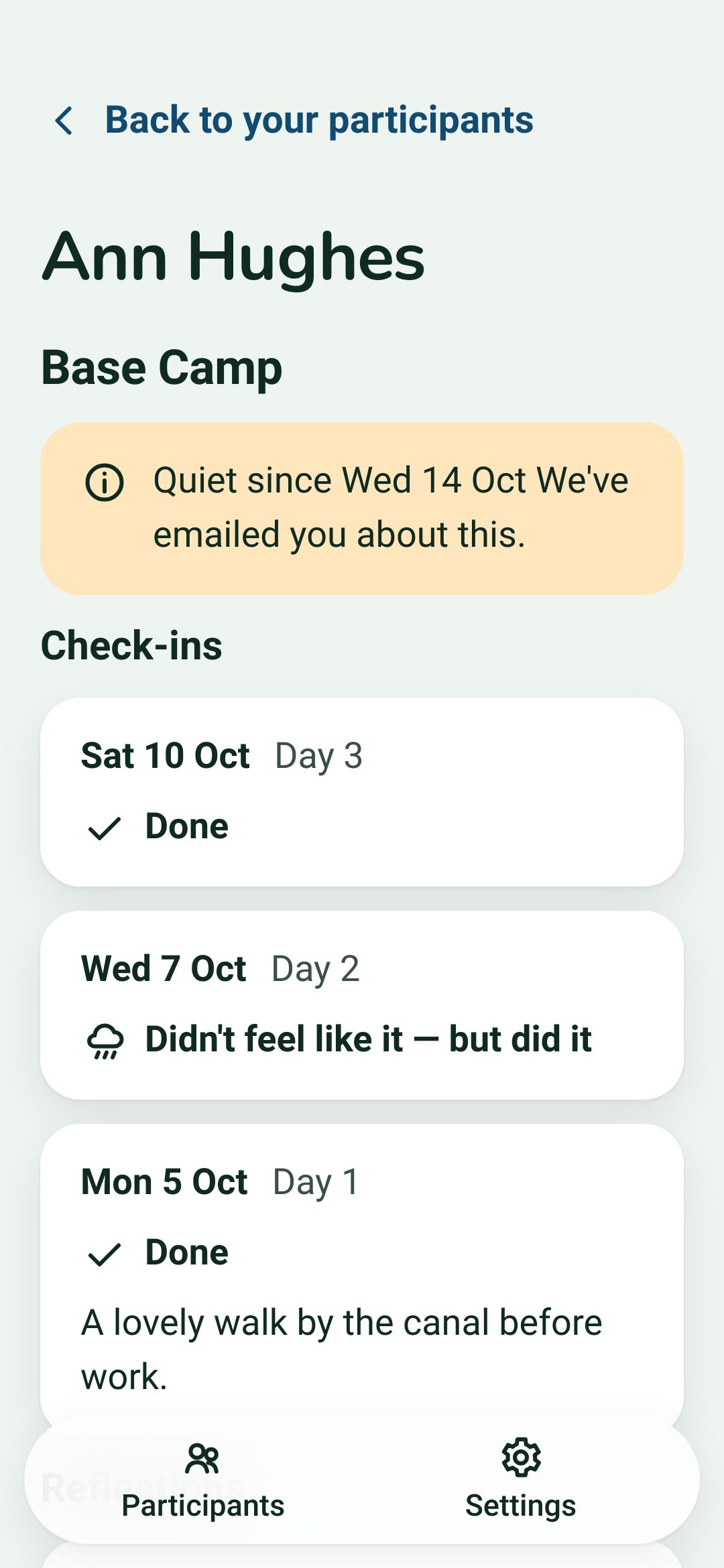
A view of each person's module, where they're up to and when they last checked in.
After three missed days in a row, you will receive an email notification, sent during your daytime. Once per quiet spell, never a daily nag.
In their own words, so you can reply meaningfully and give them the right support.
Day numbers and dates are the only numbers. Done and the rain-cloud day carry equal weight.
Never anyone else's, and nothing they do on a self-led module. Their email address and settings stay private.
Base Camp, our first module
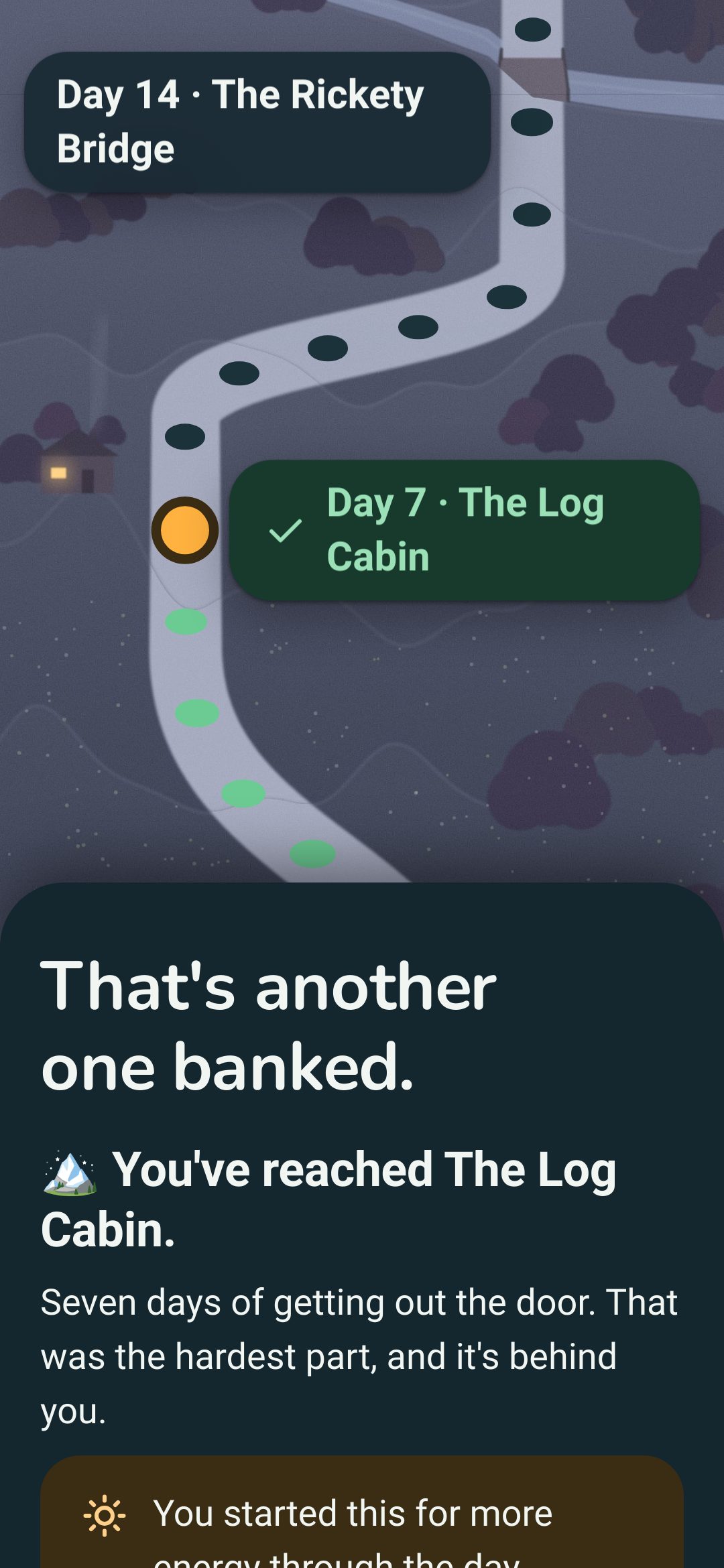
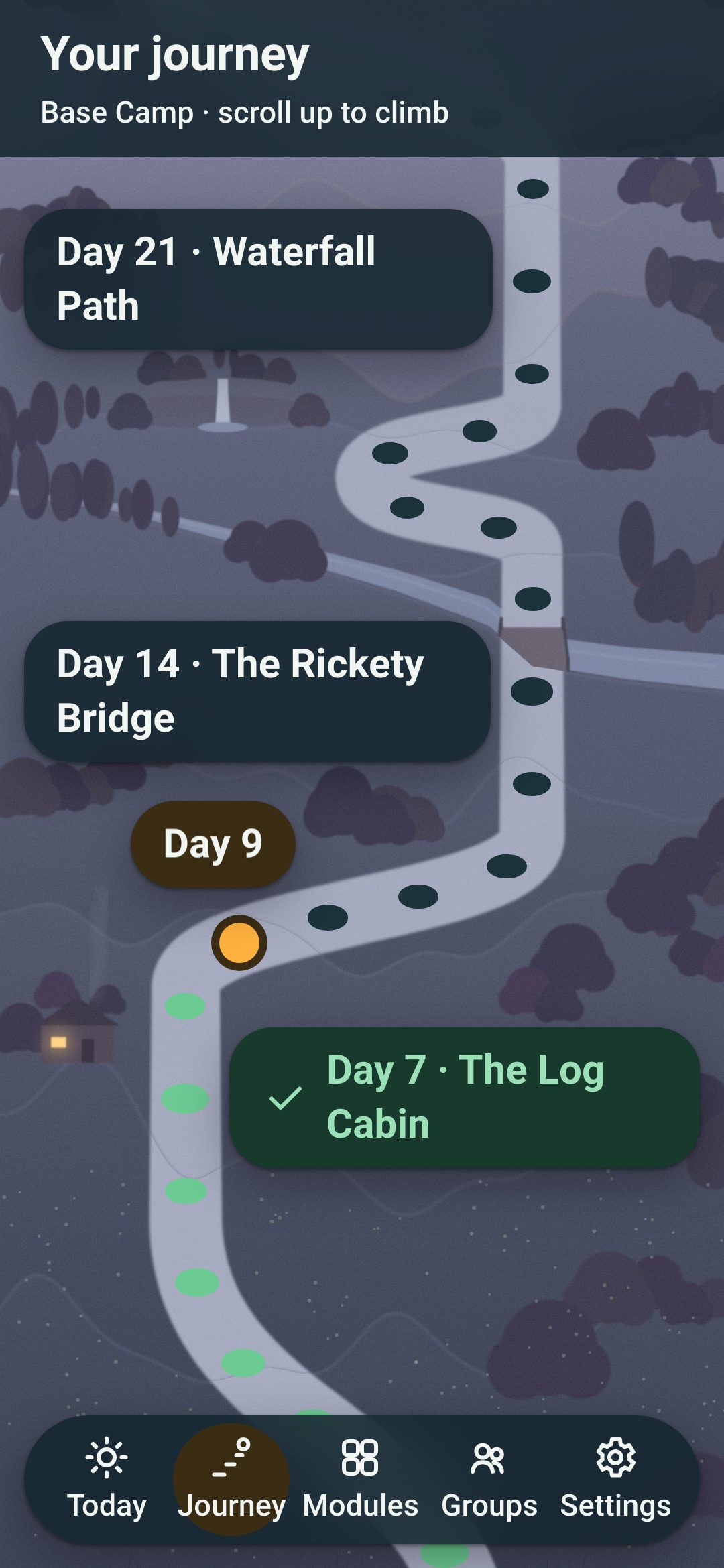
Every module follows the same weekly rhythm, so once you've run one you can run any of them. Each week ends at a named checkpoint on the trail.
A small movement per day, deliberately easy. People decide early whether you're a person or a feature, so be reliably there.
A little more is asked from here. The app previews the step up; you reassure anyone who's nervous.
The group's first shared weekend move, in a relaxed window rather than a fixed time. Sharing is always optional.
A one-to-one about life beyond week 8, by call, walk, message or written questions. It lands in the dip, when it helps most.
Gentle step-ups. Channel eagerness into a nicer route, not more intensity.
Working with the voice that says turn back, and a longer shared move.
Deliberately doing less. Rest taught as a skill.
A shared graduation move that celebrates the person rather than the distance. Then the next module, or your own offer.
Who it's for
The best fit is someone with warmth and an audience but no product of their own. Choose the one closest to you.
Personal trainers
You coach people who train. Your hours are your income, and most of your hours are already full.
Every so often someone gets in touch who hasn't moved in years. They're nervous and not ready for an hour with you, and free time here and there doesn't scale. Most of those enquiries go nowhere.
Recurring income that doesn't cost hours, a pipeline of people ready for your core offer, and a good answer for the enquiry you'd otherwise turn away.
An example
A 52-year-old messages you after watching a friend's first 5k. She hasn't run in twenty years and the gym makes her anxious. You invite her to Base Camp and read her check-ins over breakfast. By week 8 she's moving most days, she's told you what she'd like next, and she asks about your small-group mornings.
Health and wellbeing coaches
You help people change habits: sleep, stress, energy, food. You know movement matters, but you're not a fitness professional and don't want to become one.
Advice to move more rarely survives a busy week. Between your sessions nothing holds it in place, and clients arrive having "not managed it again".
A movement strand you can add to your programmes, more to work with in each session, and a reason for clients to stay with you longer.
An example
A client you see fortnightly for stress keeps saying she'll "start walking again". You invite her to Base Camp. Between sessions you read her notes and send a line when she checks in. In week 4 you use the horizon conversation to talk about what she wants beyond the eight weeks.
Planned: writing your own plans, in your own voice, on the same methodology. Two equal check-ins, no streaks, no comparison.
Social prescribing link workers
You connect people with support that isn't medical. Many of the people you see are inactive or isolated, and "try a class" is a step too far.
Referrals to gyms and groups don't land with people who find those rooms emotionally out of reach. By the time they'd feel ready, they've often stopped engaging.
An option for the people who aren't ready for groups yet, and a light-touch way to stay alongside them for eight weeks.
An example
A man in his late fifties, recently retired, says he's lost his routine. A walking group feels like too much for now. You invite him to Base Camp and glance at his check-ins twice a day. In week 3 the shared weekend move gives him a gentle reason to say hello to others, either face to face or simply in an online group.
Motion Over Mind isn't a clinical service. The app asks no health questions, so screening stays with you and your organisation. We'll share our privacy notice and data handling in full before any organisation signs up. Anonymised, aggregate reporting for organisations is planned.
Community groups and charities
You run a walking group, a community centre, or a charity that helps people get out and about. The group is the reward. Getting people to the first meeting is the hard part.
Some people never make the first meeting. Others come once, miss one, feel awkward about it and drift away.
A way in for people who wouldn't come otherwise, and a reason for newcomers to keep coming back.
An example
A village walking group runs Base Camp each spring for a handful of newcomers. A volunteer reads the check-ins over breakfast and sends each person a line. The graduation move becomes the group's summer walk, with the newcomers alongside the regulars.
Planned: an in-app group space (WhatsApp until then) and anonymised engagement figures you could share with funders.
Corporate wellbeing providers
You deliver wellbeing to employers: talks, workshops, challenges and platforms.
Step challenges and leaderboards reward the people who were already active. Everyone else quietly opts out, and participation tails off after launch week.
An offer that reaches the people your challenges miss, delivered in a format employers recognise.
An example
A provider runs Base Camp for a cohort at a regional firm, starting with a lunch-and-learn. The coach reads check-ins twice a day and replies personally. Nobody's check-ins are shared with the employer or with colleagues.
Planned: anonymised, aggregate reporting for organisations, with a privacy floor. No employer sees an individual's check-ins.
Our pilot so far
Our first cohort ran Base Camp in 2026, coached over WhatsApp before the app existed, to prove the pattern works.
Everyone was still with us at the end of the eight weeks, apart from one person who paused for an injury outside the programme. By comparison, a large UK exercise referral scheme lost half its people by week 12.
Kelly et al., Journal of Public Health, 2016 · 6,894 people
When the eight weeks ended, the whole group wanted to keep going, before a next module even existed.
People kept moving on holiday, away from home and out of their routine, and still had the group in mind.
After the programme ended, most carried on sending their daily check-in, with nothing prompting them.
The people who kept going were reporting to a person they knew.
The prompt gets people started. Being noticed is what keeps them. That's the part you bring.
Working together
We're looking for a small group of coaches to build this with after our next cohort. Here's what that means on both sides.
Where we are now, and what comes next. Timings after spring 2027 depend on what the next cohort teaches us.
Now · autumn 2026
January 2027
Spring 2027
Then
Later
Is it right for you?
Tick whatever sounds like you.
Take your time.
There's no score to hit. These are the things our coaching rests on. If most of them sound like you, it's worth a conversation.
Get in touchFAQ
For now, every coach runs Base Camp, our eight-week first module. Writing your own plans inside the platform is planned, and every plan follows the same methodology: two equal check-ins, no streaks, no comparison.
The app sends the prompts, records check-ins, keeps the journey and flags anyone who goes quiet. Your time goes on attention: reading the coach view at set times, a personal line for each check-in, and a short message at the end of each week. It grows with the number of people you coach.
On WhatsApp for now, in your own words, plus an optional group for your cohort where reading without posting is always fine. In-app messaging is planned.
A smartphone, iPhone or Android. The app will be on the App Store and Google Play; while we're testing, it installs straight from the browser. Text is large, buttons are big, and there's a dark mode.
You are, under your own qualifications and insurance. The app asks no health questions and stores no health answers. It shows one readiness line asking people to check with their doctor first if they've ever been told to.
If anyone mentions a health concern, the answer is always a warm "please get a quick GP okay first".
Your own coached participants: when they checked in, which button they tapped, their notes and their checkpoint reflections. Never anyone else's, nothing from a self-led module, and no counts, rates or rankings.
After three missed days in a row you get one email, in your daytime. The same morning, the app sends them a single gentle message and then goes silent.
Your part is one personal message that mentions something only you would know, like their reason for starting or a route they mentioned. Then patience. Nobody gets chased.
The product is the habit, not walking. People can change their movement type at any time, even day to day, and the prompt changes with it.
Graduation is a doorway. People keep their journey to look back on, and more modules are on the way. The Quiet Mile (walking and breathing, for a busy head) is written; The Starting Line and Steady Strength come next. Or they move on to your own offer.
No. There are no territories and no franchise agreement. You bring your clients onto the platform and keep your own practice.
We're agreeing terms with each founding coach, so it's something we'll talk through together. It isn't a franchise: no territories and no franchise agreement.
The app is hosted in the EU. Other coaches never see your clients, and you never see theirs. We'll share our privacy notice in full, including who can see what, before you sign anything.
Start a conversation
There's no long form to fill in and no obligation. Email the team, or use the note below to get started.
A note from the founders
We're Rich and Katie. Rich is a software developer in Oxfordshire who became an endurance athlete in midlife, and is currently training for an IRONMAN. Katie studied at the University of Oxford. She's a triathlete who plays tennis to a high standard, and cares deeply about people and their wellbeing.
Motion Over Mind takes what endurance sport taught us and leaves the performance out. We're running our next cohort ourselves, and we'd like to find a small group of coaches to build the rest of it with.
If you've read this far, we'd like to hear from you.
Rich & Katie
hello@motionovermind.co.uk